

Food and beverage brands are naturally good at attracting attention on social media. The product is visual, emotional, shareable, and easy to understand. A strong photo can create craving in seconds.
But attention is not the same as revenue.
A page can have thousands of followers, strong engagement, entertaining Reels, and still make it surprisingly difficult for somebody to place an order.
That is where many brands lose the commercial value of their audience.
A strong food and beverage digital strategy should connect content, craving, product discovery, ordering, customer data, and repeat purchase. Social media should not only make people hungry. It should make buying easier.
The real funnel is bigger than the social post
| Stage | Customer thought | What the brand needs to do |
|---|---|---|
| Attention | That looks good | Create strong visual and emotional content |
| Craving | I want that | Show texture, portion, use occasion, and product appeal |
| Decision | What should I order? | Make products, bundles, prices, and choices easy to understand |
| Conversion | How do I get it? | Provide a direct and simple ordering path |
| Experience | Was it worth it? | Deliver the product and service promised by the content |
| Retention | Would I order again? | Give customers reasons and reminders to return |
If the strategy stops at reach and engagement, most of this journey is being left unmanaged.
1. Stop treating every post as a branding post
Branding matters. Visual consistency matters. Tone of voice matters.
But a food brand does not need every post to communicate the entire brand identity.
Different pieces of content should do different jobs.
Some should create craving. Some should introduce a new product. Some should explain a bundle. Some should create social conversation. Some should remind people about delivery. Some should move directly toward an order.
The content calendar becomes much stronger when each post has a purpose beyond “we need to publish something today”.
2. Sell the craving before you sell the discount
Discounts are easy to communicate. That is why brands often depend on them too heavily.
But food is one of the few categories where the product itself can create urgency.
A close-up of melted cheese, a crisp pastry breaking open, sauce being poured, steam coming off a dish, or the first spoon entering a dessert can create desire without reducing the price.
Strong food content makes the viewer want the product before the promotional message appears.
That matters commercially because a brand that can only generate orders through discounts trains its audience to wait for the next discount.
Make sensory content do the work
Show texture, movement, sound, scale, ingredients, preparation, and the moment of consumption.
A static product shot may look beautiful, but food often becomes more powerful when people can almost imagine the taste and texture.
3. Make the menu easier to understand from social media
Imagine somebody discovers your brand through one Reel.
They like the product and visit your profile.
Now what?
Can they quickly understand what you sell? Are the best sellers obvious? Are product names understandable to somebody who has never ordered before? Can they see prices? Are bundles easy to find? Do they know which products serve one person and which serve a group?
Social media creates interest, but the next layer needs to reduce choice friction.
This is particularly important for brands with large menus. More choice does not always make ordering easier.
4. Create content around buying occasions
Customers do not always wake up wanting your exact product.
They experience a situation.
Lunch at the office. Friends coming over. A late-night craving. A family gathering. A birthday. A match night. A weekend breakfast. A gift. Something sweet after dinner.
Content that connects products to those moments makes the buying context easier to recognise.
For Egyptian F&B brands, occasion-based content can be especially useful because food buying behaviour changes around weekends, gatherings, holidays, Ramadan, seasonal events, university life, office culture, and family occasions.
You are not only selling a product. You are showing when somebody should think of ordering it.
5. Give hero products a clear role
Not every menu item needs equal media attention.
Some products are better at attracting new customers. Some have stronger visual appeal. Some carry better margins. Some naturally increase basket size. Some are valuable because customers return for them repeatedly.
Identify the products that deserve to become recognisable parts of the brand.
Then build recurring content around them rather than constantly switching focus across the entire menu.
Strong hero products can become memory shortcuts. When somebody thinks of the category, you want a specific product from your brand to come to mind.
6. Make offers solve a buying problem
An offer is stronger when it makes the decision easier, not only cheaper.
A bundle for two people solves the question of how much to order. A family box solves variety and portion decisions. An office package helps someone order for a team. A trial bundle helps a first-time customer try several products without choosing individually.
This type of offer can improve conversion while also increasing order value.
Before defaulting to a percentage discount, ask whether packaging the menu differently could create a stronger reason to buy.
7. Use social proof where hesitation actually happens
People trust other people, particularly when trying a food brand for the first time.
User-generated content, customer reactions, reviews, creator content, repeat-customer stories, and authentic product experiences can reduce hesitation.
But do not treat social proof as a separate content category that lives once a month in the calendar.
Use it close to buying decisions.
If a new product is unfamiliar, show people trying it. If a bundle is designed for gatherings, show it in a real gathering. If portion size matters, give customers a visual reference.
The proof should answer the customer’s uncertainty.
8. Make the ordering path painfully obvious
One of the simplest conversion problems is still one of the most common.
The customer wants to buy but does not know where to go.
The profile says “DM to order”, but responses take time. Another page says WhatsApp. The bio has a link containing several unrelated destinations. Delivery apps carry only part of the menu. The website exists but the ordering page is difficult to find.
Choose the primary ordering route and make it obvious.
If customers order through your website, link directly to ordering. If WhatsApp is the operating model, use a clear order CTA. If delivery platforms are important, explain where the customer can find you.
Professional social media management should consider what happens after somebody responds to the content, not only how the post performs inside the platform.
9. Reduce the number of decisions between craving and checkout
Food is often an impulse purchase.
That makes friction particularly expensive.
If somebody sees a dessert at 11 PM and wants it now, they probably do not want to browse twelve Instagram Highlights, download a PDF menu, ask whether delivery reaches their area, wait for a reply, and then manually send their order.
The shorter the path from desire to purchase, the better.
Review the journey yourself:
- See a post.
- Visit the profile.
- Find the product.
- Understand the price.
- Choose quantity or bundle.
- Enter delivery details.
- Choose payment.
- Confirm the order.
Every unnecessary step deserves to be questioned.
10. Make availability clear
Nothing kills craving like discovering the product is unavailable after deciding to order it.
If products are seasonal, limited, branch-specific, or frequently sold out, make that information easier to understand.
Campaign content and paid ads should also be updated when availability changes.
There is little value in generating thousands of views for a product customers cannot buy.
11. Branch-based brands need local relevance
A multi-branch F&B brand may have one national social presence, but ordering is local.
Availability, delivery radius, opening hours, offers, and popular items can differ by area.
A customer in Sheikh Zayed may not have the same ordering experience as someone in New Cairo or Alexandria.
Make branch information easy to access, and avoid promoting offers broadly when they only apply to selected locations unless that limitation is clear.
12. Paid media should amplify what already converts
Not every high-engagement post deserves ad spend.
A meme can generate comments without generating orders. A simple product Reel can receive fewer interactions but send highly qualified visitors to the menu.
When paid media enters the strategy, judge content by the role it needs to play.
Prospecting creative should earn attention and communicate enough product value to make somebody curious.
Retargeting can bring back people who viewed products or visited the ordering journey.
Offer campaigns can create urgency when there is a genuine commercial reason to do so.
Do not boost posts simply because they already have likes.
13. Track orders, not only engagement
Likes, comments, saves, shares, watch time, and follower growth all tell you something.
They do not tell you whether social media is producing customers.
Where the ordering setup allows it, connect the journey to commercial measurement.
Track signals such as:
- Profile visits from content.
- Menu or website clicks.
- Product-page visits.
- Add-to-cart activity.
- Orders.
- Revenue.
- Average order value.
- New versus returning customers.
- Offer redemption.
- Repeat purchase.
You do not need perfect attribution to become more commercially intelligent. You need enough visibility to understand which content and campaigns are creating useful behaviour.
14. Learn which content creates orders, not just views
Once tracking improves, the content strategy gets better.
You may discover that high-production lifestyle videos create excellent reach but product-close-up Reels create more menu visits.
A funny post may grow followers, while a customer-review carousel drives first orders.
A bundle video may not go viral but consistently increase basket size.
Those insights allow the content calendar to balance reach, brand building, and conversion instead of optimising everything for one metric.
15. Build repeat purchase into the strategy
The first order should not be the end of the funnel.
Food and beverage can be naturally repeatable, which makes retention especially valuable.
Think about what should bring a customer back.
That could include:
- New product launches.
- Seasonal menus.
- Reorder reminders.
- Loyalty programs.
- Customer-only offers.
- Birthday rewards.
- Bundles based on previous behaviour.
- Useful CRM segmentation.
If you repeatedly pay social platforms to reacquire people who have already ordered, your customer data is being underused.
16. Do not let the content promise more than operations can deliver
Marketing can create demand faster than operations can fix a bad experience.
If social media promises premium quality, fast delivery, perfect presentation, and responsive service, the actual order needs to support that promise.
Problems with packaging, delays, incorrect orders, inconsistent portions, missing items, or slow complaint handling can turn strong social reach against the brand very quickly.
The social strategy therefore needs feedback from operations and customer service.
What are customers complaining about? Which products travel badly? Which offers create confusion? Which branches struggle with certain orders?
Those are marketing insights too.
17. Community management can create or lose revenue
For food brands, comments and DMs often contain buying intent.
“Do you deliver to Maadi?”
“How much is this?”
“Is this available today?”
“Can this serve six people?”
Those are not engagement metrics. They are pre-purchase questions.
Response speed, accuracy, tone, and the ability to move somebody to the correct ordering channel can directly affect conversion.
Build clear response guidelines and give community managers access to updated menu, branch, price, offer, and availability information.
18. Build a recognisable content system, not random viral attempts
A strong F&B brand should be recognisable even before the viewer sees the logo.
That recognition can come from photography, typography, editing, humour, recurring formats, language, product presentation, or the way the brand interacts with customers.
Virality can be useful, but random viral attempts do not automatically build memory.
The strongest social media strategy creates repeatable formats that can evolve without making every week feel like a different brand.
Followers-to-orders checklist for F&B brands
- Does every content format have a clear role?
- Does product content create craving before relying on discounts?
- Can a new follower understand the menu quickly?
- Are hero products receiving enough consistent attention?
- Does content connect products to real buying occasions?
- Are bundles solving customer decisions, not only reducing price?
- Is social proof answering real buying objections?
- Is the main ordering route obvious from the profile?
- Is the path from content to checkout short?
- Are availability and branch limitations clear?
- Are paid campaigns optimised for commercial behaviour, not likes?
- Can you connect at least part of social activity to orders?
- Do you know which content creates buying intent?
- Is there a retention plan after the first order?
- Does customer service feed operational insight back into marketing?
- Can community managers answer buying questions quickly?
If your audience is growing but orders are not growing with it, the problem may not be content quality. The missing piece may be the system between attention and purchase.
FAQ: F&B social media in Egypt
How can a food brand turn Instagram followers into customers?
Create content around products and buying occasions, make the menu and prices easy to understand, show credible social proof, and provide a direct ordering path. Then track which content actually sends people toward purchases.
What type of social media content works best for restaurants and food brands?
A strong mix usually includes craving-focused product content, demonstrations, customer experiences, occasion-based content, offers, brand personality, new-product launches, and direct ordering content. The exact mix depends on the brand and commercial goals.
Should food brands post prices on social media?
When price is important to the buying decision, making it easy to find can reduce friction. If prices change regularly or vary by branch, direct customers to an updated menu rather than leaving them uncertain.
Are discounts necessary to generate orders from social media?
No. Strong products, craving-focused creative, useful bundles, social proof, convenience, and brand preference can generate demand without constant discounting. Promotions are most useful when they have a clear commercial purpose.
How should an F&B brand measure social media performance?
Use engagement and reach as supporting signals, but also track menu clicks, website visits, product interest, orders, revenue, average order value, new customers, repeat purchase, and offer usage where your systems allow it.
Is community management important for food brands?
Yes. Comments and DMs frequently contain buying questions about price, availability, delivery, portions, and branches. Fast, accurate responses can directly influence whether somebody completes an order.
If your F&B brand is getting attention on social media but too little of that attention turns into orders, book a free consultation with Mighty Leap. We can review the content, customer journey, ordering path, paid media, and retention setup to identify where followers are dropping out before they become customers.

Related articles
 12OCT
Dessert Brand Social Media: A Craveable Teardown
Dessert brand social media works when content makes people crave, remember, and share. See the creative system behind a stronger food brand presence in…
 Ramy Moussa
11 min
 14SEP
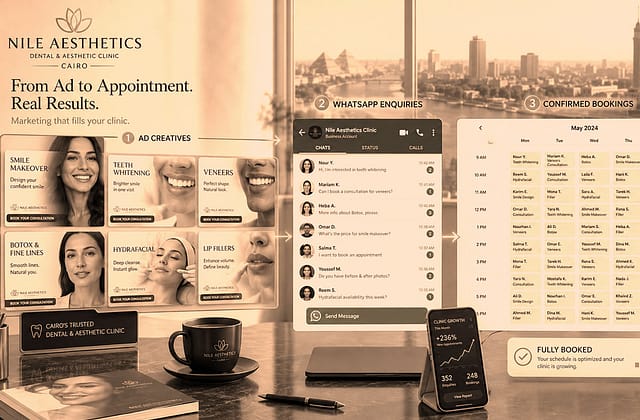
Dental & Aesthetic Clinic Ads Egypt: Get More Bookings
See how dental and aesthetic clinics in Egypt use social ads to attract qualified enquiries, improve follow-up, and turn leads into booked appointments.
Ramy Moussa
10 min