

The product looks good. That is only the starting point.
Dessert brands have an advantage on social media: the product is naturally visual. Melted chocolate, layered cakes, sauces, fillings, textures, toppings, ice cream, pastries, pancakes, cookies, and drinks can all stop a scroll when they are presented well.
But that advantage also creates a trap.
If every competitor can publish an attractive close-up of a dessert, attractive photography alone stops being a strategy. The feed starts looking like a catalogue of products rather than a brand people recognise, remember, talk about, or actively want to follow.
For food and beverage businesses in Egypt, the stronger opportunity is to build a social presence where the product, personality, visual language, content formats, and commercial moments reinforce each other. That is the thinking behind a connected food and beverage digital strategy.
This teardown looks at the strategic ingredients that make a dessert brand feel craveable online, without relying on invented campaign results or turning one creative execution into a formula for every brand.
What does a craveable social presence actually do?
| Content job | What the audience should feel | What the brand gains |
|---|---|---|
| Product craving | I want that now | Purchase intent |
| Brand personality | I know what this brand feels like | Recognition and memory |
| Entertainment | This is worth watching or sharing | Reach beyond direct buyers |
| Product discovery | I did not know they had this | Broader menu awareness |
| Occasion building | This would be perfect for tonight, a gathering, or a treat | More reasons to buy |
| Conversion | I know what to order and how | A clearer route from attention to purchase |
A strong account moves between these jobs. If every post tries to sell immediately, the feed becomes repetitive. If everything is entertainment, people may enjoy the content without remembering what the business sells.
1. Sell texture before you sell the product name
Food decisions are sensory, while social media is visual. The creative challenge is to make someone imagine a taste, texture, temperature, or bite through a screen.
That is why the most useful product content often focuses on sensory details rather than showing the complete item from a polite distance.
Think about the difference between seeing a dessert sitting untouched in a box and seeing it being cut open, pulled apart, dipped, poured, cracked, scooped, stacked, or served.
The second approach creates movement and anticipation. It shows what the customer is about to experience rather than simply documenting what the product looks like.
The hero shot should have a job
A close-up should highlight something specific: a filling, softness, crunch, sauce, steam, thickness, layers, or contrast. Otherwise it is just another food photograph.
This is particularly important in crowded categories where competitors sell visually similar products. The detail becomes part of the differentiation.
2. Build a visual language bigger than food photography
If you remove the logo from ten posts, can people still tell they came from the same brand?
That is a useful test.
Consistency does not mean using the same template on every post. It means developing recognisable decisions around typography, framing, illustration, backgrounds, props, cropping, composition, graphic elements, motion, and tone.
A brand can move between photography, reels, memes, typography, offers, illustrations, and user moments while still feeling coherent.
The objective is not a perfectly tidy Instagram grid. The objective is recognisability in the feed, where each individual post is competing for attention on its own.
3. Give the dessert a personality, not just a description
Product descriptions are useful at the point of purchase. Social media needs more.
A dessert brand can build character through how it talks about cravings, sharing, midnight orders, cheat meals, office breaks, gatherings, indecision, chocolate obsession, or the familiar argument over who gets the last piece.
These situations give the product a place in people’s lives.
Instead of saying only what the dessert contains, the content starts saying when it belongs, who it is for, and what kind of mood it fits.
That is where social media management becomes more than maintaining a posting calendar. The brand needs a repeatable editorial point of view.
4. Make the audience hungry before introducing the offer
Discount-first creative can generate attention, but food brands should be careful not to train customers to see price before appetite.
A stronger sequence often starts with desire.
Show the product. Build the craving. Make the portion, texture, flavour, or moment desirable. Then introduce the commercial reason to act, whether that is availability, a bundle, a new item, delivery, a seasonal menu, or another legitimate offer.
The distinction matters because a discount cannot make an uninteresting product suddenly feel craveable. Appetite should do part of the selling before the price enters the conversation.
5. Create repeatable content formats
A strong social account should not need a completely new creative idea every morning.
That is exhausting for the team and difficult to scale.
Instead, build repeatable formats that can carry different products and messages. For example:
- Extreme close-up product moments.
- First-bite or first-cut videos.
- Product versus product choices.
- Ingredient or topping spotlights.
- Behind-the-counter preparation.
- New product reveals.
- Relatable craving situations.
- Reaction-led short videos.
- Occasion-based recommendations.
- Packaging and unboxing moments.
- Customer-created content where permission allows.
- Simple branded typography posts that carry the brand voice.
The format stays familiar while the execution changes. This gives the brand consistency without turning the feed into one repeated design.
6. Use short-form video to reveal, not just rotate
A common food reel simply moves the camera around a product while music plays. It may look polished, but there is often no reason to keep watching after the first second.
Video becomes more effective when something changes.
A box opens. A sauce gets poured. A product is cut. A filling is revealed. Someone reaches for the last piece. One flavour replaces another. An order moves from preparation to packaging.
The content creates a tiny question, and the viewer stays to see the answer.
This does not require complicated production. In many cases, one clear action is enough to turn a static-looking product clip into a watchable piece of content.
7. Build around occasions, not just menu items
A menu tells people what they can buy. Content should help tell them why they might buy it today.
Dessert brands in Egypt have plenty of natural occasions to work with: after-work treats, weekend gatherings, visits to friends and family, birthdays, office orders, late-night cravings, university breaks, Ramadan gatherings, Eid, summer outings, and seasonal moments.
The point is not to force the brand into every calendar event. It is to find the situations where the product naturally belongs.
This creates more creative territory than repeating individual product features, and it can introduce several items through the same consumer need.
8. Do not make every post look like an advertisement
People follow food accounts because they enjoy the content as well as the food.
If every post includes a product, price, CTA, telephone number, delivery message, and promotion, the account starts behaving like a digital flyer.
Commercial information matters, but the feed needs rhythm.
Some posts can create pure craving. Some can entertain. Some can show personality. Some can introduce a product. Others can make the route to purchase extremely clear.
The result is a brand that earns attention instead of demanding it every time it publishes.
9. Let the menu create content variety
One challenge for dessert businesses is deciding what deserves attention. Hero products naturally dominate, but overusing them can make customers think the menu is smaller than it really is.
A useful content system gives different products different roles.
A visually dramatic bestseller might be the attention generator. A drink could complete an order. A smaller item might support impulse purchasing. A box could fit gatherings. A seasonal product could create urgency.
Content planning becomes more strategic when the team asks what role a product plays rather than simply asking which product has not been posted recently.
10. Design for shares and tags, not only likes
Dessert content has a natural social behaviour built into it. People send products to friends, tag someone they want to order with, debate flavours, and share something because it looks excessive or irresistible.
Creative can encourage this behaviour without filling every caption with generic requests to tag three friends.
A familiar situation, a difficult product choice, a highly craveable reveal, or a joke that feels specific to the audience can create a stronger reason to share than an explicit engagement instruction.
11. Keep ordering information close to the craving
Brand building matters, but a food account still has to help people buy.
If someone sees a product and wants it immediately, the next step should not require detective work.
Profiles, links, highlights, location information, delivery options, menus, and ordering routes should stay current and understandable. If there are branches, clarify where products are available. If availability changes, make that information easy to update.
The social content creates desire. The surrounding digital journey should make acting on that desire easy.
12. Judge the presence as a system, not one viral post
A viral reel can be valuable, but it is not a social strategy.
The stronger question is whether the brand can repeatedly create attention, product desire, recognition, interaction, and commercial action over time.
Look at patterns across content. Which products naturally generate attention? Which creative styles make people watch? Which messages produce meaningful comments, shares, profile visits, or ordering behaviour? Which formats can be repeated without becoming predictable?
Those lessons should influence the next content cycle.
That feedback loop is one reason strong creative work should be treated as part of a wider marketing system rather than isolated artwork. You can explore more examples of integrated digital work in the Mighty Leap portfolio.
The craveability checklist
- Does the content make the product feel sensory, not just visible?
- Can people recognise the brand before they see the logo?
- Does the brand have a consistent way of speaking?
- Are there several repeatable content formats?
- Does video contain an action, reveal, or reason to keep watching?
- Does the content connect products with real buying occasions?
- Is there enough entertainment and personality between sales posts?
- Are hero products balanced with broader menu discovery?
- Does some content naturally encourage sharing or tagging?
- Can someone easily order after a post creates a craving?
- Is performance feedback influencing future creative decisions?
If most of the answer is centred on how attractive the product photos look, there is probably still room to build a stronger brand system around them.
What food brands can take from this teardown
The biggest lesson is simple: craveability is designed.
The product obviously matters, but the social presence decides how that product is framed, revealed, repeated, remembered, and connected to real-life moments.
A strong dessert brand does not need every post to be completely different. It needs a clear creative world with enough rules to feel recognisable and enough flexibility to keep surprising people.
For businesses building a wider food and beverage brand presence, that combination of consistency and appetite is what turns social media from a product gallery into a genuine growth channel.
FAQ: Dessert brand social media
What makes social media content effective for a dessert brand?
Effective dessert content combines sensory product presentation with a recognisable brand personality, repeatable creative formats, relevant occasions, and a clear route to purchase. Strong photography helps, but it works best as part of a broader content system.
Should a dessert brand post product photos every day?
Not necessarily. Product content is essential, but using only standard product shots can become repetitive. Mix close-ups, short-form video, preparation moments, product choices, relatable situations, brand-led graphics, occasions, and conversion-focused posts.
What kind of Reels work for food and dessert brands?
Reels tend to become more watchable when something happens on screen. Cutting, pouring, opening, revealing, assembling, serving, tasting, or transforming a product creates a reason for the viewer to stay beyond the opening frame.
How can a dessert brand stand out from competitors on Instagram?
Build recognisable creative assets beyond the logo. Consistent typography, framing, motion, photography style, graphic elements, and tone of voice can make individual posts recognisable even when the content format changes.
Should food brands focus on engagement or sales?
They need both, but not every post needs to do both at once. Some content should build appetite and brand memory, some should encourage interaction, and some should make ordering or visiting extremely easy. The overall system should eventually support commercial action.
If your food or dessert brand has a great product but its social presence still feels like a collection of disconnected posts, book a free consultation with Mighty Leap. We can review your food and beverage content, brand system, and social media journey to identify how to make the presence more distinctive, craveable, and commercially useful.

Related articles
 26OCT
F&B Social Media Egypt: Turn Followers Into Orders
Learn how food and beverage brands in Egypt can turn social media followers into orders with stronger content, offers, ordering paths, tracking, and retention.
 Ramy Moussa
12 min
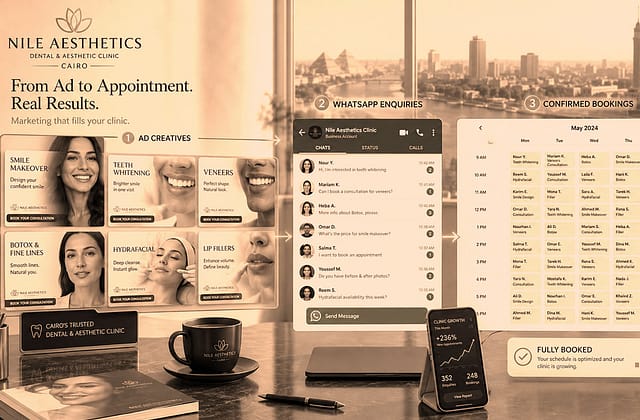 14SEP
Dental & Aesthetic Clinic Ads Egypt: Get More Bookings
See how dental and aesthetic clinics in Egypt use social ads to attract qualified enquiries, improve follow-up, and turn leads into booked appointments.
Ramy Moussa
10 min